Exit - determining exit state
LF‑ET also supports test case calculation for state-based testing in decision tables with rule groups:
-
Each rule group thus corresponds to one state
-
Each rule corresponds to one state transition
-
Rule-based systems can be described using specific exit values:
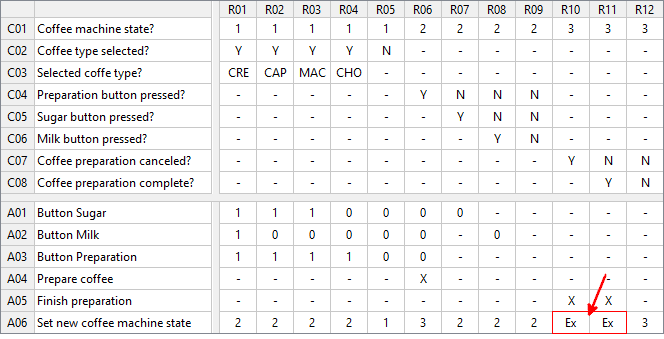
-
Rule-based systems can also be described without specific exit values, e.g. when there is no rule that would produce an exit or an "End of processing" as the next step:
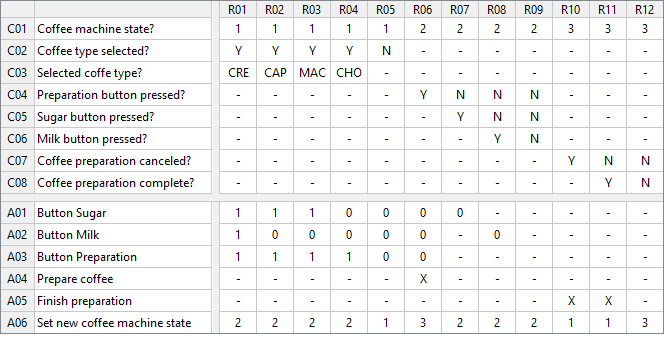
-
For systems with no exit values that iterate endlessly, LF‑ET recognizes recursions automatically and may complete the calculation of a test case in a random state or in a state that is unfavourable for testing
-
With LF‑ET therefore a rule group can be marked as a preferred exit rule group (exit state) with the test step property exit=true in the test instruction for the rule group condition value:
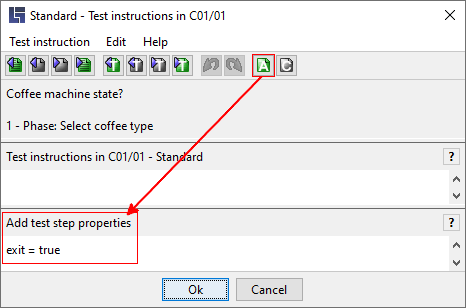
LF‑ET then attempts to complete all test cases with a rule that specifies an exit rule group thus designated as the next rule group.
In other words: LF‑ET then attempts to complete all test cases with a state transition that specifies an exit state thus designated as the next state.
In this example, all test cases should end with rule R05, rule R10 or rule R11.