Test instructions with intervals
Equivalence classes can also consist of numerical intervals. LF‑ET supports an interval notation for such intervals and optionally selects any value or the value falling precisely between defined limits for test case generation.
Notation
An interval in LF‑ET is to be specified
-
in square brackets,
the upper and lower limits of the intervals are to be separated with
-
a colon,
-
a vertical dash or
-
a semicolon.
The alignment of both dashes of brackets determines whether a given limit falls within or outside the interval.
Examples
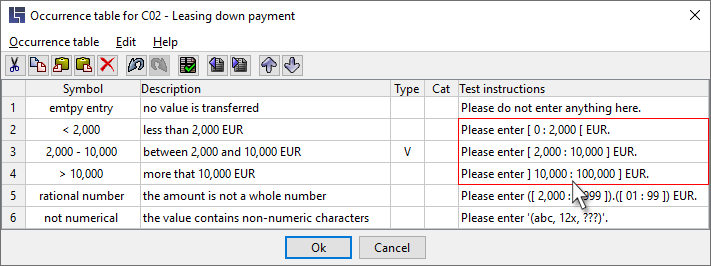
Examples from the value table are interpreted by LF‑ET as follows:
Interval entry |
Meaning |
|---|---|
[ 0 : 2,000 [ |
means an interval 0 – 1,999. The value 2,000 does not fall within the interval since the horizontal dashes of the rear bracket "point away from the value" |
[ 2,000 : 10,000 ] |
means an interval 2,000 – 10,000. The values 2,000 and 10,000 are included in the interval as the horizontal dashes of brackets "point to the interval" |
] 10,000 : 100,000 [ |
means an interval 10,001 – 99,999. Neither of the values 10,000 and 100,000 falls within the interval as the horizontal dashes in both brackets "point away from the value" |
| In order for interval entries to be more readable: spaces can be inserted before or after numerical values. |