Test instructions with categories
At present, only relevant for decision tables with rule groups; hence, for example in test case generation, preferably test cases without hints or error messages can be created and produced as first.
A defined behaviour of a system can be an error message generated.For this reason it is not rare to find an action in a decision table in which error messages are deposited.
If the decision table additionally contains rule groups, a test case is made up of not a single rule but a chain of several rules.As regards rule groups, LF‑ET attempts, when generating a test case, to cover 100% of rules, attaining the smallest possible number of rule chains. One of the consequences may be that in certain circumstances at least one error message is contained in most rule chains.
From the point of view of a test analyst, such a result is not desirable as they cannot properly test running of the system in this way.
The test analyst can thus provide certain condition or action values with categories in order to classify them e.g. as error or warning. When generating a test case, the test analyst can use the option "Prefer test cases without equivalence class categories" in order to obtain a set of test cases in which only rules without these classified condition or action values are present. This set thus covers the positive test cases and the number of negative test cases usually gets smaller.
The CAT column
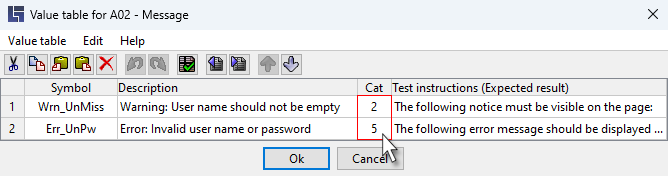
In the value table editor, if the display of test instructions is activated, there is the "Cat", i.e. category of test instruction. Any integers greater than zero are permissible.
Test instructions can be assigned here to different categories as necessary, e.g. "Hint", "Warning" or "Error message". Any integers greater than zero are allowed: