Generation options for equivalence class partitioning
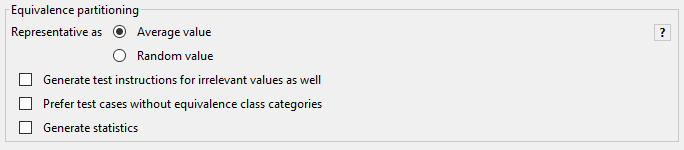
Representative as an average value or a random value
Values are selected from equivalence classes, entered as intervals, for generating specific test cases. LF‑ET then offers both possibilities "Average value" and "Random value".
When the "Average value" is selected, LF‑ET determines the average value of the interval. In each test case in which the equivalence class is selected, always the same representative is tested. The specified average value is always provided with the same degree of detail as provided for in the test instruction.
If the "Random value" option is set, LF‑ET determines each time the random value that falls within the defined interval. If the equivalence class is used in more than one test case, specified values are usually different.
See also: Test instructions with intervals.
Generating of test instructions also for irrelevant values
The option "Generate test instructions also for irrelevant values" is used to turn rules containing an irrelevant condition into specific rules. This means that LF‑ET replaces the "irrelevant" symbol with a random value of the condition and thus also generates corresponding test instructions for this condition.
Hint: During random selection of values LF‑ET takes into account possible settings for particular types of equivalence classes. A value that represents a valid equivalence class is always selected.
Preferring test cases without equivalence class categories
At present only relevant for decision tables with rule groups. For example, when generating test cases, the system can be set to prioritize identifying and outputting test cases without warnings or error messages first.
See also: Test instructions with categories.
Generate statistics
The "Generate statistics" option serves informative purposes only.
LF‑ET uses this option to produce statistics that show test analysts if and to what extent the desired test coverage has been reached with the generated test cases.
In addition, LF‑ET provides an overview of which specific values can be used in which rules and which test cases. The test analyst can thus evaluate the quality of provided test data.