Decision table combinations
A decision process can be described by linking multiple decision tables or a decision table with itself to a decision table combination.
Linking forms include: loop, sequence, branch, nesting.
Loops, sequences and branches can be reproduced very well in LF‑ET also through rule groups, only in the case of nesting, links to 'real' sub-decision tables must be used.
Loop
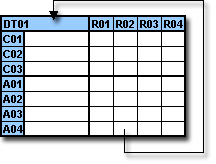
A decision table forms a loop if at least one rule leads directly to a new interpretation of this decision table.
Sequence
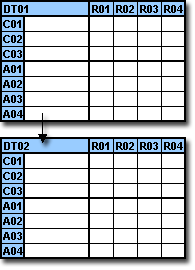
Two decision tables form a sequence if the second decision table is the only immediate successor to the first.
Branch
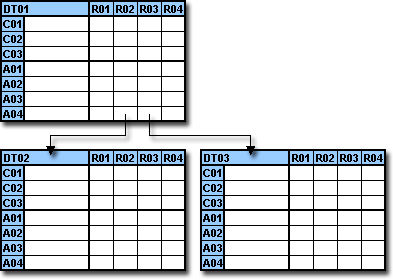
Decision tables form a branch if the first decision table alternatively has several immediate successors.
Nesting
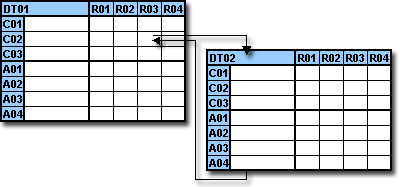
Two decision tables are nested when the second decision table is fully interpreted in order to test a condition or perform an action.
This is an example in which the second decision table is used to determine a condition value.
Combination of linking forms
Linked decision tables are referred to as a decision table combination.
In the previous chapters, possible linking forms for decision tables were presented, i.e. loop, sequence, branch and nesting.
In each of these linking forms, a decision table combination can result instead of a decision table.