Testability
An essential quality feature of decision tables is the possibility of internal analysis, especially if they can be performed by tools – virtually at the push of a button.
There are usually three different types of analysis, which are briefly presented below.
Completeness analysis
A decision table is complete if it contains all the conditions, actions and rules that are important for the decision situation. The following completeness analyses can be performed:
Completeness analysis |
|---|
|
|
| For the feasibility of the completeness analysis, there must not be any redundancies or contradictions. |
Redundancy analysis
A decision table contains redundant decision rules if:
-
for a condition constellation of reality several rules in the table apply
-
and the action display parts are identical in terms of content
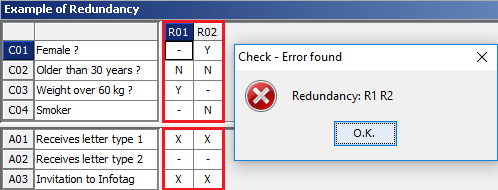
In the example above, e.g. all female non-smokers under the age of 30, weighing over 60 kilograms, are covered both by rule R01 and R02.
Since both rules perform the same actions, it is an example of redundancy.
Contradiction analysis
A decision table contains contradicting decision rules if:
-
for a condition constellation of reality several rules in the table apply
-
and the action display parts are different in terms of content
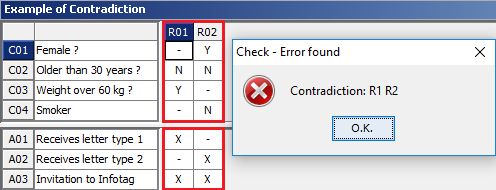
In the example above, e.g. all female non-smokers under the age of 30, weighing over 60 kilograms, are covered both by rule R01 and R02.
Since the rules perform different actions, it is an example of a contradiction.