Version 2.2.0
Test case generation
With the new, optionally available generation of test cases, including export to test management and test execution tools, the fields of application of LF‑ET have been extended by a third area:
-
Specification creation
-
Program generation
-
Test case generation
Bulk import of conditions and actions
Sometimes lists of values need to be mapped as conditions or actions in decision tables. For this purpose, a powerful import function has been created, which allows even greater numbers of conditions or actions to be imported from external sources into a decision table.
More details: Bulk import of conditions and actions
Interval Detection for condition and Action values
LF‑ET now recognizes interval notations not only in test statements, but also in the symbols and descriptions of condition and action values.
In addition to interval notation in square brackets…
] ‑Inf : 30 ] |
all integer values less than or equal to 30 |
[ 31 : 50 ] |
all integer values from 31 to 50 |
[ 51 : Inf [ |
all integer values greater than or equal to 51 |
...LF‑ET is now capable of "understanding" and recognizing also a simplified representation of number ranges for condition and action values, such as, e.g.
<= 30 |
all integer values less than or equal to 30 |
31 - 50 |
all integer values from 31 to 50 |
>= 51 |
all integer values greater than or equal to 51 |
The simplified notation is recognized if a greater than or less than sign has been used for at least one value, and it is treated in the same way as the regular interval notation:
-
Automatic recognition of the number of decimal digits
-
Checking for gaps and overlaps in the values of a condition
|
With existing decision tables it can thus happen in individual cases that warnings are displayed for conditions with recognized interval gaps or overlaps. This can be easily checked "area-wide" with the List-DT function. However, when generating programs, detected overlaps are classified as errors, which would prevent generation for the affected decision table. If reported overlaps cannot or should not be cleaned up, then a check of simplified interval specifications for individual programming languages can be deactivated with the generation parameter DontCheckIntervals. |
Command line functions
Limit removal for the number of parameters
A new, optional notation, can be used to bypass operating system limits for the number of parameters when calling command line functions.
More details: No limits for the number of arguments in function calls
Function names
The names of some functions have been improved, e.g. -List is now -List-DT, -CAList is now -List-CA, etc.
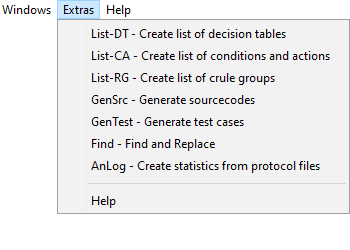
Downward compatibility is ensured: previous (old) function names are no longer documented, but they continue to function as usual in the long term, so that adjustments are not absolutely necessary on the user side.
-List-DT
The content of the decision table list has been expanded, new columns now additionally provide the following information:
RG |
The number of rule groups in the decision table |
UDV |
The eventually set user-defined version of the decision table |
Wrn Err |
The number of warnings and errors detected during automatic check of a decision table |
More details: List-DT
-List-CA
The list of all conditions and actions from decision tables has also been expanded in content, new columns now additionally provide the following information:
RG |
Indicates whether the condition is a rule group condition (RGC) or whether the action is a rule group action (RGA) |
*V |
Specifies the number of values of a condition or action |
More details: List-CA
-List-RG
This new function analyzes all relationships between nested decision tables and their rule groups.
Since a rule group can be considered a process step, this list provides a good overview of the process steps contained in a process, including the interrelationships and the respective quantity structures, such as rules, conditions and actions contained in each process step.
More details: List-RG