Enum for condition C01
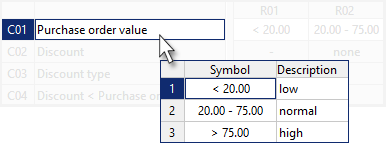
Starting point
2 methods are generated by default for condition C01 for the first two condition values:
/**
* <b>C01: Purchase order value</b><br>
* <br>
* <b>C01/01: < 20.00 - low</b>
*/
boolean isPurchaseOrderValue_Less2000();
/**
* <b>C01: Purchase order value</b><br>
* <br>
* <b>C01/02: 20.00 - 75.00 - normal</b>
*/
boolean isPurchaseOrderValue_20007500();One method should only be generated now and values transferred as enums for this condition.
Extending the configuration
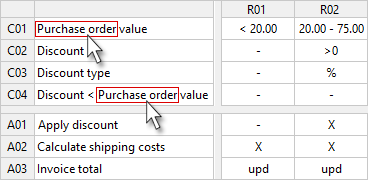
Since these configuration extensions are intended specifically for the decision table, they are defined for the decision table in a new configuration file for decision table. It has the same name as the decision table, however, with the extension ".yaml":
lfet:                          # 1)

  ide.java:

    interface.enum:            # 2)
      1:
        symbol: Interval
        include.tags.title: purchase order
        exclude.tags.title: discount
The entries in detail |
|||||
|---|---|---|---|---|---|
|
|||||
|
|||||
|
|||||
|
|||||
Results for C01
Only one method left
-
No longer a method for every condition value
-
But only one method for the condition
-
Values are passed as an enum in each case
/**
 * <b>C01: Purchase order value</b><br>
 * <br>
 * The enum generation has been triggered in project.ini by:<br>
 * - <b>ide.java.interface.enum.1</b>: symbol=Interval; include.tags.title=purchase order; exclude.tags.title=discount
 */
boolean isEnum(InvoiceTotal_iFace.PurchaseOrderValue arg0);
An enum
-
An enum value for every condition value
-
For conditions not for the last value (here >75), since an ELSE branch is always generated for this
-
If all values are required in the application, it can be determined with the key interface.enum.options: allValues
-
In addition, in this example technical information is taken over from the decision table during generation:
-
value symbol as a string
-
upper and lower limits of intervals
-
including the associated GETTER and evaluation methods
-
-
Technical data can be automatically machine processed
/**
* <b>C01: Purchase order value</b><br>
* <br>
* The enum generation has been triggered in project.ini by:<br>
* - <b>ide.java.interface.enum.1</b>: symbol=Interval; include.tags.title=purchase order; exclude.tags.title=discount
*/
enum PurchaseOrderValue
{
/**
* <b>C01: Purchase order value</b><br>
* <br>
* <b>C01/01: < 20.00 - low</b>
*/
$001("< 20.00", Double.NEGATIVE_INFINITY, 19.99),
/**
* <b>C01: Purchase order value</b><br>
* <br>
* <b>C01/02: 20.00 - 75.00 - normal</b>
*/
$002("20.00 - 75.00", 20.0, 75.0);
private final String symbol;
private final double symbolMin;
private final double symbolMax;
PurchaseOrderValue(String symbol, double symbolMin, double symbolMax)
{
this.symbol = symbol;
this.symbolMin = symbolMin;
this.symbolMax = symbolMax;
}
public String getSymbol()
{
return symbol;
}
public double getSymbolMin()
{
return symbolMin;
}
public double getSymbolMax()
{
return symbolMax;
}
public boolean isInSymbolInterval(double d)
{
return d >= symbolMin && d <= symbolMax;
}
public boolean isInSymbolInterval(int i)
{
return i >= symbolMin && i <= symbolMax;
}
}
Implementation adjustment
This is the only manual adjustment, all the others are generated automatically.
- Previously: 2 methods for C01
-
In the original version, 2 methods still had to be implemented for condition C01:
/** * <b>C01: Purchase order value</b><br> * <br> * <b>C01/01: < 20.00 - low</b> */ @Override public boolean isPurchaseOrderValue_Less2000() { return model.getOrderValue().compareTo(bigDecimal(20.00)) < 0; } /** * <b>C01: Purchase order value</b><br> * <br> * <b>C01/02: 20.00 - 75.00 - normal</b> */ @Override public boolean isPurchaseOrderValue_20007500() { return model.getOrderValue().compareTo(bigDecimal(20.00)) >= 0 && model.getOrderValue().compareTo(bigDecimal(75.00)) <= 0; }

- Now: Only one method
-
Thanks to enum generation only one method is necessary now.
/**
 * <b>C01: Purchase order value</b><br>
 * <br>
 * The enum generation has been triggered in project.ini by:<br>
 * - <b>ide.java.interface.enum.1</b>: symbol=Interval; include.tags.title=purchase order; exclude.tags.title=discount
 */
@Override
public boolean isEnum(InvoiceTotal_iFace.PurchaseOrderValue arg0) {
    return model.getOrderValue().compareTo(bigDecimal(arg0.getSymbolMin())) >= 0 &&
            model.getOrderValue().compareTo(bigDecimal(arg0.getSymbolMax())) <= 0;
}
Automatically customized method calls in the rules module
if (iface.isEnum(InvoiceTotal_iFace.PurchaseOrderValue.$001)) // < 20.00 - low
{
    // Rule R01 ---->

    iface.doTrace("InvoiceTotal", "20260215.065057", 7, 1);

    iface.doCalculateShippingCosts();
    iface.doInvoiceTotal_Upd();

    // Rule R01 <----
}
else if (iface.isEnum(InvoiceTotal_iFace.PurchaseOrderValue.$002)) // 20.00 - 75.00 - normal
{
    if (iface.isDiscount_Greater0())
    {
Advantages
-
Implementation and maintenance of methods for conditions and actions is considerably more efficient with enums:
-
instead of one implementation per value
-
now only one implementation per condition or action
-
-
In many cases, technical changes to the values in the decision table can be mapped purely via the enums and the rules module so that implementation of methods is not affected
-
changing numerical values or other content
-
new or deleted values
-
etc.
-
-
Technical data, such as numbers, number series, intervals, texts, etc., can be transferred to the application securely and efficiently during generation.