The 'else value' in the case of conditions
If it cannot be guaranteed that a value table covers all theoretically possible values of a condition, the last value must be defined as the 'else' value. This applies to all states that do not correspond to any of the previously defined values.
A '?' or '*' is recommended as a symbol for an entry in a value table.
Example
For querying the account balance, the value defined was only less than and equal to zero. The greater than zero possibility, which has not been defined yet, is also logical:
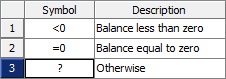
This logical gap is intercepted if the user defines an else value. It is displayed if all logical states cannot be displayed with the values already defined.
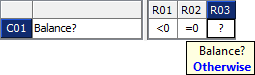
As a result, one is required to define exactly what actions should be taken even for values that are actually unexpected, already during rule creation.