Standard sorting
In standard sorting, all rules are sorted in ascending order according to the values of the conditions and actions. The position of the values in the value tables is used to determine the sort order.
The Standard sorting  function is always active if the current order of rules does not correspond to standard sorting:
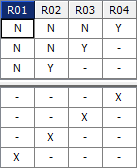
Once sorting is executed, LF‑ET "knows" that the order of rules corresponds to the standard sorting and the function is deactivated:
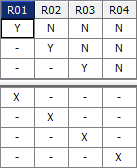
Why is standard sorting important?
-
Standard sorting is a prerequisite for secure and unambiguous communication, as it is often very deliberate about individual rules.
-
Stored and printed decision tables are therefore always automatically sorted according to standard sorting.
-
Guaranteed bidirectional traceability: Before each program and test case generation, the decision table is also automatically sorted internally according to standard sorting, so that the rule references between the program code and the decision table are always guaranteed to match.