Valid and invalid equivalence classes
The row of a value table represents a value or a number of values that can be interpreted by a test analyst as an equivalence class.In the case of equivalence classes (condition values) the test analyst differentiates between valid and invalid equivalence classes.
An equivalence class is described as valid if the system is expected to be able to process the values of the equivalence class properly. Values from an invalid equivalence class cause the processing to be aborted and, as a rule, result in an error message on the part of the system.
As LF‑ET can generate specific test cases, test instructions must also be determined by LF‑ET for irrelevant conditions.When the type of equivalence class is defined, it is guaranteed that for an irrelevant condition a test instruction belonging to a valid equivalence class is selected.
The TYPE column
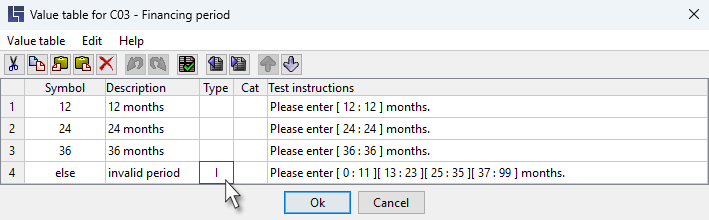
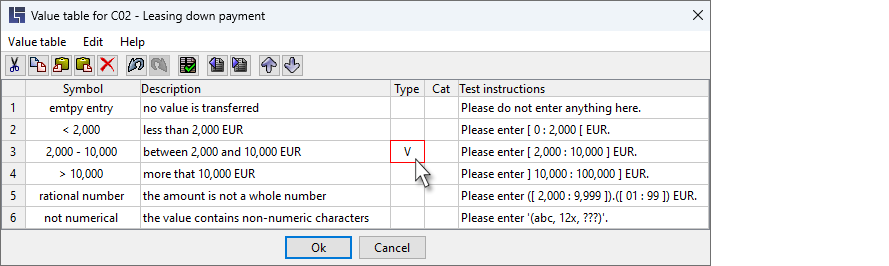
If no entries are made in the "Type" column, all rows are interpreted as valid equivalence classes.
Accepted entries in the "Type" column are as follows:
It is sufficient to designate either valid or invalid equivalence classes.
Example 1
In the example below, as per the requirements, there should be a payment between 2,000.00 and 10,000.00 Euros and all other entries should produce an error message. In this case it should be enough to put a "V" (for valid) in one row and empty entries in other rows are automatically interpreted as invalid:
Example 2
In another case it should be possible to choose a financing period of 12, 24 or 36 months. All other entries are not valid. In this case, it is easier to simply mark an equivalence class with "I" (for invalid). All other rows in which the column is not filled out are then automatically interpreted as valid equivalence classes: